Zvuk slunečních hodin

(The Sound of the Sundial)
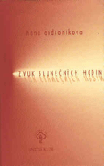

About the book

Original title Zvuk slunečních hodin
First published 2001
Publisher Euromedia Group - Knižní klub, Prague
Pages 285
ISBN number 80-242-0698-7
Languages Czech, Belarus, Hungarian, Bulgarian
Awards Book Club Prize 2001
The Magnesia Litera Prize 2002


back to top

Rights sold to

Hungary Ulpius Ház - Budapest
Belarus Logvinov - Minsk
Bulgaria SemaRSh - Sofia
United States Plamen Press - Washington


back to top

A few words

This mature, readable and at the same time cultivated novel combines several totally different environments, time plans and genres: The Bata concern in the town of Zlín, the 1930's in India where Bata was active, the Second World War, a Nazi concentration camp and contemporary America.

The story sets off with the coincidental meeting of two Czech emigrants in Colorado, who, as it turns out, have something very personal in common from the past. In short scenes and flashbacks, interlarded with notes from letters and diaries, a stirring story is revealed, at the centre of which is a fatal romance between the engineer Tomáš Keppler and a Jewish girl called Rachel, seen through the eyes of their son Daniel.

A real page turner that was awarded in 2001 with the Book Club Prize and in 2002 with the Magnesia Prize for Discovery of the year.


back to top

What the press says

Lidové noviny, 27/04/2002, by Kateřina Ondřejová

Hana Andronikova's first book wins the Magnesia Litera Award For Talent of the Year
The literary community has a new and, for this country, well publicised award, the Magnesia Litera. Its first winners were announced last Saturday. Winner of the Talent of the Year Award was the first novel by the young native of Zlín and Prague graduate in English and Czech studies, Hana Andronikova.

The prose work "discovered" in this way is a novel set partly in pre-war Zlín, partly in India and partly in Colorado in the US; a work unafraid of strong feelings and suffering and not confined to personal experience, a work which enlists a kaleidoscope of historical settings from a variety of backgrounds, not only Czech. The Sound of the Sundial is in fact "discovered" for the second time, having won the competition run last year by the Book Club, which shortly thereafter published the winning manuscript.

In his after-word to the book, the English Studies scholar Miroslav Jindra writes in superlatives about his former student: "An incontestable talent, promising beyond all doubt, has appeared in our literature." We have to agree with him.

Generator of Memories
The context of the action is a meeting between two Czech émigrés in a mountain pension in Colorado in the US where Dan Keppler has come with his family to celebrate the New Year. By chance it turns out that the owner of the pension, Anne Vanier, knew his mother. This discovery lets loose a flood of memories which emerge at random and gradually put together a picture of First Republic Czechoslovakia, the war years, and the fate of Dan's family.

The stories revived by Anne and Daniel's memories eventually live a life of their own. According to the rules of modern storytelling, the person (Dan or Anne) who starts off telling the story is subsumed into the text so that someone else can take over the telling, someone who knows the events and characters much better than would be humanly possible for the one reminiscing.

Thanks to this approach the past of individual characters is uncovered, characters who represent themselves through their diaries, memories, letters. Thus, for example, the diary kept by Anne's husband during the war becomes part of the novel, although he is already dead by the time Anne meets Dan. It is thanks to the storytelling of Anne, who experienced Theresienstadt and deportation to Auschwitz with Daniel's mother Rachel, that Daniel learns the circumstances of his mother's death, which until then had been veiled in mystery.

Love between Euphoria and Ruin
The central dramatic aspect of the whole book is the relationship between Dan's parents Rachel and Thomas - a strong and passionate love accompanied by giddiness and euphoria during their life together in India, where Thomas Keppler works for the Bata shoe company. During the war it changes for him into ruin and loss of meaning once Rachel disappears from his life.

Rachel, her father, Dan and his grandson love myths. The telling of tales creates islands of peace, relaxation and sociability, they bring relief from suffering. One of the main characters is the sun - which also finds its way into the title of the novel: in one episode Thomas Keppler makes a sundial whose dominant feature is made up of his own, Rachel's and Dan's signs of the Zodiac. The sundial is a symbol of love, family and happiness. At the end, Anne says of Rachel and Thomas: "He was her sundial. And Rachel was the sun."

Unafraid of Strong Feelings
Andronikova confidently makes use of all the formal devices of modern storytelling, such as alternation of narrators, jumps in time, passages from a diary, newspaper cuttings and letters. However, in the complex story these procedures are not used as an end in themselves, nor as a theme, as they tend to be in contemporary post-modern prose. These are means used in a simple way, serving the construction of the text. They create a varied and variable but still firm substratum to the whole action of the novel.

The book is full of action, while at the same time Andronikova's language is very poetic. On the one hand she delights in compound structures without a verb following one after the other; on the other in almost bare sentences, similarly lined up without conjunctions. On the one hand such expression makes a very austere impression, it can describe events in very rapid sequence; on the other, there are passages written in this form often full of imagery, lyrical, approaching poetic prose.

"Savitree. Fate. Bare feet, rough, blackened skin on her heels; she jabbed it into the weak spots of a skeleton barely able to move. Savitree, I repeated to myself in silence. Savitree. The dull clatter of wooden wheels on the cobblestones. Ah, Savitree, my wretched Savitree. The sound of her name and the thudding of the stick on the moulting coat of the mule, these blows cut into my young soul like the bridle into the mouth of the exhausted animal. Her face contorted with strain and anger, childish, innocent and wonderful, wild and inhuman. I looked into her. Savitree."

The magic of the language of this book does not count only in the syntactical particularities of the text. Apparent here is the author's wide vocabulary and sense for language. The text is full of witty and imaginative conjunctions of words, similes and metaphors ("Her voice was a dagger, a garden of fear."; "As she walked, her ample body flowed gracefully as though being poured out of one dish into another, changing shape and returning to its original form."; "He burst out laughing. Laughter like an iron boot.")

The author handles strong emotions and pathos. It is a field in which there is always a danger that the text will sound platitudinous. Several times Andronikova balances on the very border of cliché, but fortunately never crosses it. The fact that she stands the test in the end relates the reader still more to the action, attracts attention, enchants. In the present age, which has swung toward banal stories in which deep feelings, tragedy and human heroism are preferably not exhibited for admiration, the author's courage in launching herself into such a high-flown storyline is refreshing.

From India to the Theresienstadt Ghetto
Interrupting the chronology enables the author to set the happy time, which Thomas and Rachel spend in India, against the reality of the concentration camp in which Rachel finds herself on her own, without her beloved husband. For a European, it is difficult to accept the destruction and extinction that accompanies everyday life in India. Again and again the revealing image of the burning of the dead and blazing sacrifices - the Indian funeral ritual - monstrously and distortedly returns in the far more absurd, savage and futile form of the final solution to the Jewish question. The variety of impressions, colours, tastes, perfumes, the feeling of warmth and radiance are exchanged for a uniform greyness, horror, hunger and cold.

This is Fiction
Another speciality of the novel is a very carefully worked out portrait of the period context and local atmosphere. The book includes a list of the literature used by Andronikova as a source of information, information which is an important construction element of the novel as a whole.

Both at the beginning and in the after-word we are warned that the novel is fiction and contains a minimum of autobiographical echoes. The portrait of the period context is very carefully worked out and the author "explains" the local atmosphere by the attached list of literature (about the war and the holocaust, about India and mythology) which again is not a usual part of a work of fiction /in the Czech Republic/. The need to declare herself so clearly at a distance from "historical reality" is on the whole understandable in light of the strongly authentic resonance of the book as a whole, and the fact that real historical figures sometimes flit through the pages. However, this external emphasis on the fictional quality of the story forces the reader to pause again over the author's ability to develop the fate of people from whom she is divided by several generations, and over her spontaneous delight for story telling; particularly after experiences with a majority of Czech writers desperately lacking any imaginative or story-telling ability, many of whom find themselves in difficulty once they have run out of their own autobiographical material.

The fact that Hana Andronikova does not let herself be seduced into self-preoccupied descriptions and considerations, does not rely only on her powers of narrative and cultivated style, that she tries to capture a remote reality with respect for the truth, gives us hope that The Sound of the Sundial will not be her last book.


back to top


Context, no. 13, by Petr Hanuška

Hana Andronikova's (1967) first book The Sound of Sundial puts its author among the prominent young authors of the new Czech literary wave that emerged after the Velvet Revolution. The intimate relationship between two individuals, complicated by the adversity of fate and historical accounts, is one of the most prominent subjects of European national literatures after 1945. The setting Andronikova chooses for the convoluted human dramas of The Sound of Sundial, are the two crucial war conflicts of the 20th century. With an especially strong emotional charge and artistic eloquence, she elaborates on the topic of Holocaust. Andronikova manages to avoid using simplistic and stereotypical structures of motives utilized so often in literature.

Her interpretation of the Jewish liquidation is depicted here through a story of the main character, Rachel. Andronikova uses testimonies of her own family and enriches this picture and the colorfulness of the narration by adding direct and indirect quotations from contemporary magazine and newspaper articles. The narrative level of the novel is substantially modified by time, which in this case, is approached as an architectonic shaping device. The novel is like a thread and each plot twist represents a separate stitch of a different color; the colors alternate in an irregular order - but not illogically - in order to lock the circle by a final pull.

The contemporary story line is based on a meeting of two Canadian Czechs who meet during their vacations in a Colorado mountain resort. Their memories, which intersect and link, create a key to the stories told. The author opens the first door, and then takes the reader on a rather discontinuous tour through one chamber after another. This excursion is as absentminded as people's real thoughts and memories. However, thanks to the author's precise work, the reader does not confuse the various threads and can identify the disappearing and reappearing characters, locations, and timelines. The timelines of the book can be distinguished as the eras of grandparents, parents, and children and all together they cover the period between the breakup of the Austro-Hungarian Empire and the rising totalitarian communism in Central Europe.

Andronikova is a dynamic storyteller. Any description of a place, situation or of the characters' state of mind is charged with vibrant suspense and anticipation. The power lays in the authors' ability to create a cinematographic picture, in which the situational and descriptive sequences quickly follow one another. But in no way the movie-like character of the story makes the narration a compound of superficial suggestions or fragments. It is just the other way around. The author shows her talent in creating a very detailed enumeration without losing the narrational dynamism. She builds up dramatic dialogues and creates powerful soliloquies, which encompass life determination and misfortune, but also beauty.


back to top


Excerpt

After Mrs Stella Weinstein died Regina and Rachel divided up her jewel-box between them. Three months later they were to surrender all valuables to the prudent care of the Reich. Rachel and Regi took certain things away from their parents' house; some they gave to friends and relations, while Rachel brought some home.
      Then they were summoned to the Gestapo office in Prague-Střešovice. After being kept waiting for hours they were led inside. A young, handsome Gestapo officer politely explained that they would like to buy from them two houses in Vinohrady and some land in Jevany. The piece of paper he placed before them said that they were selling the land and houses to the Third Reich voluntarily for one million crowns. He wanted them to sign.
      "We can't sign this. It's all co-owned by our brother, who's abroad. We don't have the authority." The Gestapo man gladly explained that it didn't matter; we aren't concerned about details like that. Finally he started yelling that he'd have them locked up. They understood and signed, voluntarily. Regina accompanied Rachel to the station. As they stood at the ticket-office, Rachel suddenly stopped and burst out laughing. Regina, show me that paper. Regi blinked quizzically at her sister. She rummaged in her handbag and pulled out the document, rubber-stamped and signed by the representative of the Reich. Rachel couldn't stop laughing.
      "We sold our house for this scrap of paper! What a bargain! This calls for a drink." By the time they headed for the platform their feet were leaden with wine and their heads all the lighter: no more worrying about the family real estate.

Dad worked hard at our emigration. He was in touch with Uncle Erik and was trying to get us to England or America. Permits to emigrate were ultimately approved by the Gestapo. Not for everyone.
      A whole year's effort bore the fruit we longed for. Dad managed to get the affidavit enabling us to emigrate to America. After the transfer of the Weinsteins' property into the claws of the Third Reich, gratis, the Gestapo whacked a big rubber stamp on the approval to leave. There was one small catch. The consulates of most countries in warring Europe were closed at the time and to get transit visas for the countries we could travel through and then board ship to sail for the New World was a mammoth task. Moreover an emigration passport was valid for a limited time only. Twelve months. A Gordian knot which might be our undoing, and finally it was. By the time we obtained our transit visas the exit permit had expired. This meant starting the whole agony afresh. And time was flying and the war was consuming money, days, countries and people.


back to top