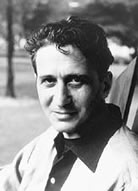
Egon Hostovský


About the author

Un écrivain excellent

Milan Kundera

Egon Hostovský(1908-1973) is one of the authors who shaped Czech literature during the interbellum and who helped to give form to the Middle-European literature represented by writers like Franz Kafka, Joseph Roth and Stefan Zweig etc. (Hostovský and Zweig were cousins). Despite of the fact that he had success with his work in the United States during the fourties and fifties - about nine of his books were published in English and a couple in German and French - he became forgotten as an author.

Hostovský made his debut in the late 1920's and his books are labelled as psychological novels. But at the same time there was praise for his fine ability story telling. He was hailed as a great talent and in 1935 he made his name as an important author with the novel Žhář (The Arsonist - USA 1996). For this book he was awarded the Czechoslovak State Price for Literature. The novel sketches amongst others the surfacing tensions, envy, mistrust between Czechs, Germans en Jews. In retrospect one could say that Hostovský subconsciously foresaw already the human tragedy that would take place a couple of years later, though he would not have expected the cruelty and scale of this tragedy. Another important novel from the pre-war period is the psychological family tragedy Dům bez pána (A House Without a Master) from 1937.

When WWII breaks out Hostovský flees to Paris and via Portugal ends up in New York. There he works for the Czech government in exile and is befriended with Jan Masaryk, son of the former president who later became the Minister of Foreign Affairs. During these war years he publishes perhaps one of his most remarkable novels: Úkryt (The Hideout - USA, 1943). In this short novel he makes use of his own experiences when he was forced to flee Paris in 1940 amidst a large mass of despairing refugees trying to escape before the advancing German army. Hostovský ended up in Normandy before he could make his way to Portugal.

After the war Hostovský returns to Prague where he publishes in 1947 one of his most impressive novels: Cizinec hledá byt (A Stranger is Looking for Accommodation). When the communists seize power in 1948 Hostovský leaves his country, but now permanent. Via Denmark and Norway he ends up in the United States again. He uses the theme of the communist coup in his new novel Nezvěstný (Missing - USA , 1952). The book is published in a Danish translation and in 1952 the American edition comes out. It is not until 1955 that with help of some friends the original Czech book can be published. Missing got positive reviews in the American press, like in The New York Times, The Saturday Review and The Chicago Sunday Times: 'One of the most original and moving novels of the year'. Hostovský captured in this book the dark atmosphere of Prague in these days of turmoil, full of fear, conspiracies and mistrust. He pushed the existentialist nature of his work to a new height, surely influenced by Franz Kafka and Graham Greene, though turning it into something new and original. Graham Greene, a great admirers of Hostovský's work, remembers his encounter with him in connection with his novel Missing: "My first meeting with Egon Hostovský had some of the flavour of his own works", Graham Greene wrote in 1958, "a complex flavour of black humour, melodrama and despair. It was in Prague during the week of the Communist Revolution. Hostovský came into my hotel room straight from a last meeting at his Foreign Office with his beloved chief Masaryk - who was to suffer a defenestration a few days later. We sat on the bed finishing my bottle of Scotch whisky and the streets outside were noisy with processions of trade unionists, shouting away their freedom."

After Missing Hostovský publishes several other novels in the United States. Of these one should certainly mention Půlnoční pacient (The Midnight Patient - USA, 1954). Graham Greene said about this book: "On one level The Midnight Patient is an up-to-the-minute thriller of the world of cold war, containing scenes of excitement and of nightmare humour that would have attracted Hitchcock in his great days. But on a second level it is literature - a fine and original novel that takes a sombre stand for the values of trust in a world dominated by fear of the neighbour."

About his own work Hostovský said: "During my lifetime I have witnessed activities of great personalities, and I have been touched by great historical events. I am able to talk about Josef Stalin and Billy Graham; I saw in person Nikita Kruschev shoulder to shoulder with president Eisenhower, and I saw and even heard Elvis Presley; I can talk about the astronauts and the Beatles, about war in South Asia and the remarriage of Elizabeth Taylor. Haunted by all these experiences, I have been trying, independently of psychiatrists, to find a key to our troubled times and to build in my literature a place of spiritual security for myself and my readers."

After his death the Egon Hostovský Prize was founded. Among the laureates are Ludvík Vaculík and Jáchym Topol.

back to top

Bibliography (selection)

Publication Published in Published by
Případ profesora Kornera (The Case of Profesor Korner) 1932 Melantrich, Prague
Žhář (The Arsonist) 1935 Melantrich, Prague
Dům bez pána (A House Without a Master) 1937 Melantrich, Prague
Úkryt (The Hideout ) 1945 Random House, New York
Cizinec hledá byt (A Stranger Is Looking for Accomodation ) 1947 Melantrich, Prague
Nezvěstný (Missing ) 1952 The Viking Press, New York
Půlnoční pacient (The Midnight Patient) 1955 Heinemann, London
Dobročinný večírek(The Charity Ball) 1957 Heinemann, London
Všeobecné spiknutí (The Plot) 1961 Doubleday, New York


back to top

Translations (incomplete)

!-- BEGIN VAN EEN RIJ -->
Publication Publisher Translated by
Žhář
L'Incendiaire 1947, Éditions Stock, Paris M.L. Hirsch
The Arsonist 1996, Twisted Spoon Press, Prague Christopher Morris
1
Dům bez pána
Het testament 1939, Nederlandse Keurboekerij, Amsterdam A.E. Boutelje
La Maison sans maitre 1949, Plon, Paris F. Bérence
1
Úkryt
The Hideout 1945, Random House, New York Fern Long
The Hideout 2017, Pushkin Press, London Fern Long
Skjul 2019, Silkefyret, Aarhus Josef Suchanek
De schuilplek 2021, Zirimiri, Amsterdam Edgar de Bruin
1
Cizinec hledá byt
Vreemdeling zoekt kamer 1 2018, Zirimiri Press, Amsterdam Edgar de Bruin
1
Nezvěstný
Missing 1952, The Viking Press, New York Ewald Osers
Zaginiony 2016, Ksiażkowe klimaty, Wroclaw Andrzej Jagodziński
Serbian edition in progress Blum izdavastvo, Beograd
1
Půlnoční pacient
The Midnight Patient 1955, Heinemann, London Philip H. Smith
Le Vertige de minuit 1957, Éditions Robert Laffont, Paris Michel Manoll
Der Mitternachtspatient 1958, Zsolnay Verlag, Wien Utta Roy-Seifert
1
Dobročinný večírek
The Charity Ball 1957, Heinemann, London Philip H. Smith
La Charité mène le bal 1959, Robert Laffont, Paris J. and P. Cep
1
Všeobecné spiknutí
The Plot 1961, Doubleday, New York Alice Backer and Bernard Wolfe
Das Komplott 1964, Diana Verlag, Konstanz Iris und Rolf Hellmut Foerster.
1
Sedmkrát v hlavní úloze
Seven Times the Leading Man 1945, L. B. Fischer, New York Fern Long
Siebenmal in der Hauptrolle 2004, Deutsche Verlags-Anstalt, München Markus Sedlaczek


back to top